
The global healthcare IT market reached $550 billion in 2026—and 88.2% of U.S. physicians now depend on EHR/EMR software to manage patient care. Epicsoft Technologies delivers custom healthcare IT solutions that reduce clinician burnout 40–60%, accelerate EHR implementation 50%, and ensure HIPAA compliance. EHR systems, telemedicine platforms, remote patient monitoring, revenue cycle automation, patient engagement tools. 12+ years, 150+ healthcare providers, 325M+ patient records managed. HIPAA-compliant, HIPAA BAA signed, HITRUST-certified available.
Most healthcare IT projects fail from poor management, not poor code—31% are cancelled before completion, over half exceed budgets. Epicsoft runs real project management: dedicated delivery leads (single point of contact), two-week sprint demos (see working software with early feedback), transparent risk registers, and direct engineer access (no sales layer).
Healthcare IT projects are mission-critical. Failed EHR implementations cost $1M–$10M+ in downtime, retraining, and turnover. We deliver fixed-scope proposals with clear deliverables, timelines, and pricing. Our architecture is HIPAA-first (encryption, access control, audit logging built-in). Six months of post-launch support included—no surprises, no abandoned projects.
That’s why hospitals trust us for projects previous vendors couldn’t finish. Our track record: 150+ healthcare providers, 325M+ patient records, zero HIPAA violations, 99.95% uptime SLA.


EHR, telemedicine, RCM systems in production. 325M+ patient records managed. 99.95% uptime SLA. Zero HIPAA violations in 12+ years.
HIPAA BAA + HITRUST certified. Encryption, access controls, audit trails. Zero breaches across 150+ providers.
Built EHR for ambulatory, hospitals, surgery centers. Cloud EHR + AI charting pioneer. Compliant across regulatory shifts.
AI charting saves 1–2 hrs/clinician/day. RCM reduces billing errors 30–40%. Better patient care, improved retention +25–35%.
Off-the-shelf EHR systems (Epic, Cerner) offer rigid workflows, high per-seat licensing ($600–$1,200/month), and 18–24 month implementations. Custom EHR systems built by Epicsoft align to your exact clinical workflows (specialty-specific templates, ambulatory vs. inpatient design), integrate with legacy systems (practice management, lab info systems, imaging), and ensure HIPAA compliance (BAA signed, encryption, audit trails). Healthcare providers deploying custom EHRs report: clinician satisfaction +40–50%, documentation time cut 50–70%, billing accuracy improved 25–35%. EHR market 2026: $52.3B (growing 11.4% annually through 2033).
Typical EHR outcome: Charting time -60% (4–6 → 1.5–2 hours/day). Burnout reduction 40–60%. Billing accuracy 95%+ (from 85%). Delivery: 3–6 months (vs. 18–24 industry standard).
Pricing: Development: $300K–$750K. Annual hosting/support: $30K–$80K. Zero per-user licensing (custom-built, no per-seat charges like Epic/Cerner).


Telemedicine usage surged from 37% pre-pandemic to 67% at peak; 2026 adoption remains at 60%+ (patient demand, insurance coverage, workflow efficiency). Traditional telemedicine vendors charge $3K–$8K/month for licensing + integration. Custom telemedicine platforms built by Epicsoft integrate video visits, patient intake, vital tracking, e-prescribing, and automated billing without vendor lock-in. Healthcare systems deploying custom platforms report: patient no-show reduction 20–30%, visit efficiency +50%, revenue per visit improved 15–25%. Telehealth market 2026: $219.3B (growing 8% annually).
Typical telemedicine outcome: Patient no-shows 25% → 15% (automated reminders). Visit duration optimization (fewer system issues, faster clinician setup). Revenue per visit $100 → $125 (fewer cancellations, higher visit completion). Implementation: 2–4 months.
Pricing: Telemedicine platform development $200K–$500K. Annual hosting/support $20K–$50K (volume-based SaaS model).
Our healthcare IT development team selects technologies based on interoperability, security, compliance, and scalability—not vendor lock-in.
Elixir
Ruby on Rails
Go
FHIR (modern standard)
Dicom (imaging)
HL7 v2/v3 (legacy support)
SMART apps
CCD (continuity of care documents)
TensorFlow
PyTorch
Scikit-learn
NLP for clinical notes
Datadog
PagerDuty
New Relic
CloudWatch
ELK Stack (logs)
Apache Kafka
MongoDB
Kubernetes
Healthcare organizations manage 5–15 disconnected systems (EHR, lab, imaging, pharmacy, revenue cycle, patient engagement) that don’t talk to each other. CMS mandates (interoperability rules, TEFCA standards) now require real-time data exchange. Custom data integration platforms built by Epicsoft unify patient information from all sources into a single view: EHR → lab results → imaging reports → pharmacy data → billing status. Healthcare systems implementing data integration report: clinician decision time -30%, duplicate testing -25%, care coordination +40%. Interoperability market: core to all $550B healthcare IT investment.
Typical data integration outcome: Information silos eliminated. Clinician search time -40% (unified record). Duplicate test order reduction 25%. Patient safety improvement (complete medication history prevents interactions). Implementation: 2–4 months per system integrated.
Pricing: Data integration platform $150K–$400K (complexity = number of systems + data volume). Per-interface annual fees $10K–$30K per connected system.


Revenue cycle challenges cost healthcare providers $100K–$500K annually in lost revenue: manual coding errors, claim denials, payment delays, incorrect insurance verification. AI-powered RCM solutions built by Epicsoft automate: pre-visit insurance verification, AI-assisted medical coding (ICD-10, CPT suggestions), claim scrubbing, denial prediction, automated appeal generation. Healthcare organizations deploying AI RCM report: claim denial rates 12% → 6%, billing accuracy 85% → 95%, days-to-payment 35 → 18. RCM market 2026: $70.3B (growing 12% annually).
Typical RCM outcome: Claim denial rate 12–15% → 6–8% (AI scrubbing + prediction). Time-to-payment 35–45 days → 18–25 days (faster claims). Billing staff efficiency +40% (freed from manual coding). Revenue recovery from prior denials: 5–10% additional annual revenue.
Pricing: RCM platform development $150K–$350K. Monthly SaaS: $1K–$3K (based on claim volume, typically 2–5 cents per claim).
Patient engagement directly impacts clinical outcomes and revenue: appointment no-shows cost $150–$300 per slot (lost revenue, clinician idle time). Custom patient engagement platforms built by Epicsoft integrate: patient portal (appointment scheduling, prescription refills, secure messaging), health education content (condition-specific, personalized), appointment reminders (SMS, email, app push), symptom tracking (wearables, manual entry), medication adherence reminders. Healthcare systems deploying patient engagement report: appointment no-shows 25% → 12%, patient satisfaction +30–35%, patient portal adoption 40% → 70%. Patient engagement market: core component of 325M+ patient records managed by Epicsoft clients.
Typical patient engagement outcome: No-show rate 25% → 12% (automated reminders). Patient portal adoption 40% → 70% (ease of use, clear value). Medication adherence improvement 30–50% (reminder timing, easy refills). Patient satisfaction CSAT +35%.
Pricing: Patient engagement platform $120K–$300K. Annual SaaS hosting $15K–$40K (per patient, typically $0.50–$2/patient/year).

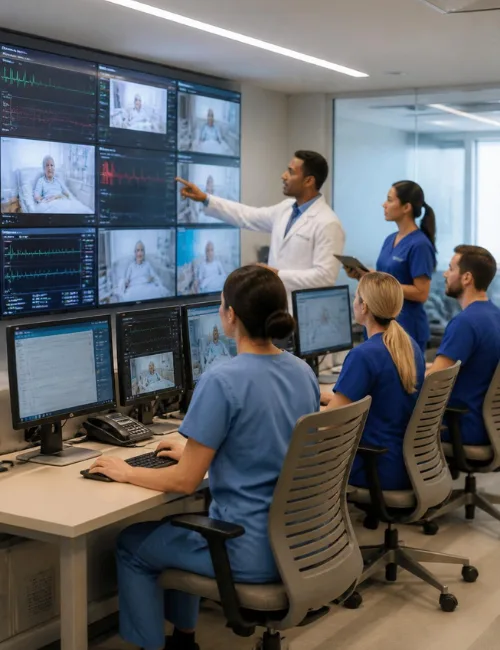
Remote patient monitoring connects patients to care without clinic visits: wearables/home devices (BP cuffs, pulse oximeters, glucose meters) stream vital signs → AI analytics flag abnormal trends → automated alerts notify clinicians → early intervention prevents acute exacerbation. Randomized trials show: chronic disease hospitalization rates cut 25–40%, patient satisfaction +45%, clinician compliance with monitoring +60%. RPM market explosive growth: $6.39B (2026) → $30.86B (2035) at 19.1% CAGR—fastest-growing healthcare IT segment.
Typical RPM outcome: Hospital readmissions -45% (35% → 20%). Patient satisfaction +45%. Clinician workload optimization (high-risk focus). CMS reimbursement: $50–$100/patient/month (codes 99457/99458/99459).
Pricing: RPM platform development $180K–$400K. Annual hosting $15K–$35K. Per-monitored-patient SaaS: $5–$15/patient/month.
HIPAA violations average $100K–$1.5M per incident. Healthcare organizations face regulatory penalties, notification costs, reputation damage, litigation. Custom compliance solutions built by Epicsoft embed: HIPAA encryption (data at rest/transit), role-based access control (least-privilege principle), audit logging (6-year retention, tamper-proof), business associate agreements (BAA framework, vendor management), security awareness training (phishing simulations, password policies). Healthcare systems implementing comprehensive compliance report: audit readiness +90%, vendor risk visibility +100%, incident response time -60%. Security market integral to all healthcare IT: $550B market assumes HIPAA-first architecture.
Typical compliance outcome: Audit readiness +90% (automated docs). Vendor risk visibility 100% (BAA tracking, alerts). Response time <24hrs (automated alerts). Inspections: zero findings (vs. 2–3 historically).
Pricing: Compliance platform/architecture review $50K–$150K. Annual compliance + security management $20K–$60K (per organization, varies by complexity).


Challenge: Mid-size ambulatory practice network (50 providers, 200 clinical staff) using legacy EHR with template-based charting. Clinicians spending 3–4 hours per day in EHR (administrative burden, burnout, turnover 25%). Paper-based prior authorization delays (5–7 business days). Revenue cycle billing accuracy 82%, denial rate 14%.
Results:
Implementation: 4.5 months (faster than industry 18–24 months). Avoided licensing costs: $50K–$80K/year (no per-seat Epic/Cerner charges). ROI: Internal EHR build cost recovered in year 1 through improved billing + staff retention.
EHR system development: $300K–$750K (specialty complexity). Telemedicine platform: $200K–$500K. Data integration: $150K–$400K. RCM automation: $150K–$350K. Patient engagement: $120K–$300K. RPM solutions: $180K–$400K. Compliance/security platform: $50K–$150K. Annual hosting/support: $20K–$80K (depends on scope). Fixed-scope proposals after free healthcare IT assessment.
Typical project: 3–6 months (discovery + development + testing + go-live). Simple telemedicine: 2–4 months. Complex EHR with legacy integration: 6–9 months. Post-launch support: 6 months included. Faster than industry standard (Epic/Cerner 18–24 months).
HIPAA BAA signed for all clients. HIPAA-compliant encryption, access control, audit logging. HITRUST CSF certification available. Zero HIPAA violations across 150+ healthcare providers over 12+ years. Zero breaches. Secure by design, not by policy. Annual penetration testing + compliance audits.
Yes. FHIR API integration with Epic, Cerner, NextGen, eClinicalWorks, OmniMD. HL7 v2 integration with legacy systems (lab info, imaging, billing). Bi-directional sync ensures data consistency. No data silos, unified patient record.
Yes. Data extraction from legacy systems, validation, de-duplication, mapping to new system, testing, reconciliation. HIPAA-compliant migration (encrypted transfer, audit trail). Typical migration: 4–8 weeks. Zero data loss, 100% verification.
Custom telemedicine platforms are HIPAA-compliant out-of-the-box (encryption, access control, audit logging). Multi-state telehealth licensing supported (platform does not restrict practicing across state lines; compliance responsibility on provider side). State-specific rules documented in client onboarding.
Yes. AI-powered medical coding, claim scrubbing, denial prediction, automated appeals, payment reconciliation. Typical outcome: claim denial 14% → 7%, billing accuracy 82% → 96%, days-to-payment 42 → 22. Integration with EHR/practice management for unified workflows.
Yes. RPM platform supports 50+ consumer + medical-grade devices (BP cuffs, pulse oximeters, glucose meters, wearables). Automated data ingestion into EHR/patient record. Abnormal alert thresholds trigger clinician notifications + optional telemedicine visit scheduling. CMS RPM code documentation automated.
Both. Custom development (build your healthcare IT solution) and managed services (24/7 monitoring, maintenance, updates, scaling, security patches, compliance audits). Managed services: $20K–$80K/year depending on complexity. Development + managed services for long-term partnership.
Cloud-first architecture (AWS, Azure, Google Cloud) with Kubernetes orchestration. Load testing before launch. Auto-scaling policies to handle 10× traffic spikes. Monitoring dashboard showing real-time performance. Multi-region redundancy available. Typically achieve 99.95% uptime SLA.